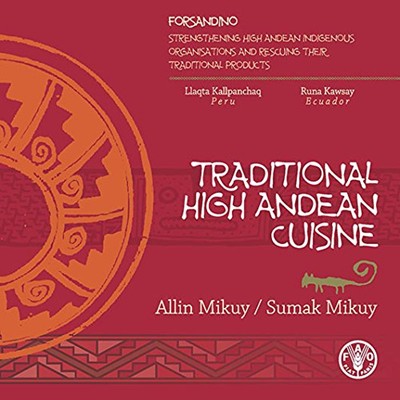
Traditional High Andean Cuisine by Food and Agriculture Organization of the United Nations
This book has not been indexed yet...
Notes about this book
You must Create an Account or Sign In to add a note to this book.Reviews about this book
- ISBN 10 9251065241
- ISBN 13 9789251065242
- Format Paperback
- Page Count 222
- Language English
- Publisher FAO
Publishers Text
The vast geographical extension and specific soil and climate conditions of the Andes have produced an especially rich flora and fauna. In these regions, important pre-Colombian civilizations developed, whose diverse ethnic groups learned to work the land and develop efficient agricultural systems adapted to the region’s variable--and at times extreme--climatic conditions. The social, economic and cultural cohesion they achieved was based on the production of a broad variety of traditional crops including tubers, roots, cereals, vegetables, fruits and the raising of animals such as guinea pigs and South American camelids.Indigenous people account for more than 30% of the population in Andean countries and 90% of them depend on traditional farming both for their livelihoods and as a direct source of food. The productive systems that they inherited from their ancestors – and which they have since jealously preserved and developed – offer important biological and technological advantages. Strengthening these systems is one of the main challenges facing those who seek to fight poverty in the region, which affects more than 80% of the population and condemns more than 45% of infants to conditions of chronic malnutrition.
Reviving traditional products and ancestral knowledge associated with national/regional cooking makes it possible to expand the food base, improve nutritional conditions and food security, and to generate additional sources of income for rural households. Without a doubt these crops are of great nutritional value, are highly adaptable to severe environmental conditions, and greatly enhance the value of family farming, especially in the case of indigenous peoples.
Other cookbooks by this author
- Afrontar La Escasez de Agua: Un Marco de Accion Para La Agricultura y La Seguridad Alimentaria
- Afrontar La Escasez de Agua: Un Marco de Accion Para La Agricultura y La Seguridad Alimentaria
- Compendium of Food Additive Specifications: 76th Meeting 2012
- Compendium of Food Additive Specifications: Joint Fao/Who Expert Committee on Food Additives. Seventy-Seventh Meeting 2013
- Lait Et Produits Laitiers
- Leche y Productos Lacteos: Comision Fao/Oms del Codex Alimentarius
- Maize in Human Nutrition
- Milk and Dairy Products in Human Nutrition
- Milk and Milk Products: Fao/Who Codex Alimentarius