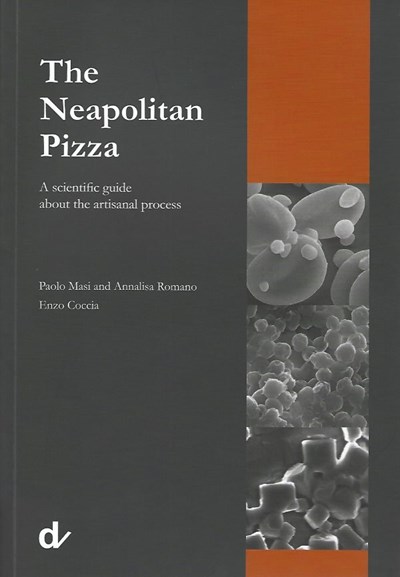
The Neapolitan Pizza: A Scientific Guide About the Artisanal Process by Paolo Masi and Enzo Coccia and Annalisa Romano

This book has not been indexed yet...

Notes about this book

This book does not currently have any notes.

You must Create an Account or Sign In to add a note to this book.

Reviews about this book

This book does not currently have any reviews.

  • ISBN 10 8889972556
  • ISBN 13 9788889972557
  • Published Jan 01 2015
  • Page Count 168
  • Language English
  • Countries Italy

Publishers Text

Given the global success achieved by this product and the degree of excellence reached by artisan pizzaioli everywhere, even outside of the country where this simple but delicious product was born and reached its popularity, one wonders why we would want to observe it with the rigour of a scientific approach. After careful consideration this choice might not appear all that strange. If one wants to look beyond the folklore, the empiricism, the clichés and false beliefs, the only way to do that is to understand why certain phenomena develop in one way rather than another, why some raw materials give rise to some results and others to different results, why slight differences in the preparation lead to pizzas with certain sensory characteristics rather than others. Understanding the relationship between the composition of raw materials and the behavior of the dough, the structure of the dough and the organoleptic characteristics of the pizza, is the only way for a pizzaiolo to understand how and when to intervene in order to reach the desired result or correct any mistakes. This will enable him to achieve complete mastery of the pizza making process, an art which has developed thanks to the practical experience of Neapolitan pizzaioli through centuries, and made pizza a local speciality. Excerpt from the foreword by the authors Far from being a mere commodity, a product separated from the social and cultural dynamics of its production, pizza is food at the centre of a social ritual. It is at the centre of a koine` at the centre of which are the oven and the pizzaiuolo's worktable. It is no coincidence that in traditional Neapolitan pizzerias ovens are not hidden; they are in the centre of the room, like an ancient fireplace. The pizza maestro does not have his back to the customers; he faces them and interacts with them at all times; there is a constant collective feedback. Excerpt from the presentation by Marino Niola