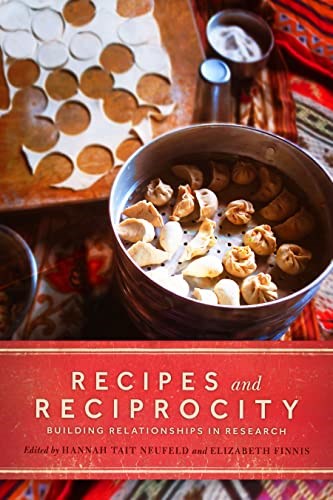
Recipes and Reciprocity: Building Relationships in Research by Hannah Tait Neufeld and Elizabeth Finnis

This book has not been indexed yet...

Notes about this book

This book does not currently have any notes.

You must Create an Account or Sign In to add a note to this book.

Reviews about this book

This book does not currently have any reviews.

  • ISBN 10 0887552978
  • ISBN 13 9780887552977
  • Published Aug 19 2022
  • Page Count 222
  • Language English
  • Countries Canada
  • Publisher University of Manitoba

Publishers Text

Recipes and Reciprocity considers the ways that food and research intersect for both researchers, participants, and communities demonstrating how everyday acts around food preparation, consumption, and sharing can enable unexpected approaches to reciprocal research and fuel relationships across cultures, generations, spaces, and places. Drawing from research contexts within Canada, Cuba, India, Malawi, Nepal, Paraguay, and Japan, contributors use the sharing of food knowledge and food processes (such as drying, steaming, mixing, grinding, and churning) to examine topics like identity, community-based research ethics, food sovereignty, and nutrition. Each chapter highlights practical and experiential elements of fieldwork, incorporating storytelling, recipes, and methodological practices to offer insight into how food facilitates relationship-building and knowledge-sharing across geographical and cultural boarders. Contributors to this volume bring a range of disciplinary backgrounds?including anthropology, public health, social work, history, and rural studies?to the exploration of global and Indigenous foodways, perceptions around ethical eating and authenticity, language and food preparation, perspectives on healthy eating, and what it means to develop research relationships through food. Challenging colonial, heteropatriarchal, and methodological divisions between academic and less formal ways of knowing, Recipes and Reciprocity draws critical attention to the ways food can bridge disciplinary and lived experiences, propelling meaningful research and reciprocal relationships.