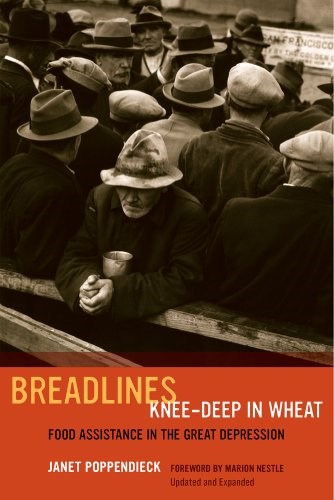
Breadlines Knee-Deep in Wheat: Food Assistance in the Great Depression (California Studies in Food and Culture) by Janet Poppendieck
This book has not been indexed yet...
Notes about this book
You must Create an Account or Sign In to add a note to this book.Reviews about this book
- ISBN 10 0520277546
- ISBN 13 9780520277540
- Published Apr 26 2014
- Format Paperback
- Page Count 400
- Language English
- Edition Upd Exp
- Countries United States
- Publisher University of California Press
Publishers Text
At no time during the Great Depression was the contradiction between agriculture surplus and widespread hunger more wrenchingly graphic than in the government's attempt to raise pork prices through the mass slaughter of miliions of "unripe" little pigs. This contradiction was widely perceived as a "paradox." In fact, as Janet Poppendieck makes clear in this newly expanded and updated volume, it was a normal, predictable working of an economic system rendered extreme by the Depression. The notion of paradox, however, captured the imagination of the public and policy makers, and it was to this definition of the problem that surplus commodities distribution programs in the Hoover and Roosevelt administrations were addressed.
This book explains in readable narrative how the New Deal food assistance effort, originally conceived as a relief measure for poor people, became a program designed to raise the incomes of commercial farmers. In a broader sense, the book explains how the New Deal years were formative for food assistance in subsequent administrations; it also examines the performance--or lack of performance--of subsequent in-kind relief programs.
Beginning with a brief survey of the history of the American farmer before the depression and the impact of the Depression on farmers, the author describes the development of Hoover assistance programs and the events at the end of that administration that shaped the "historical moment" seized by the early New Deal. Poppendieck goes on to analyze the food assistance policies and programs of the Roosevelt years, the particular series of events that culminated in the decision to purchase surplus agriculture products and distribute them to the poor, the institutionalization of this approach, the resutls achieved, and the interest groups formed. The book also looks at the takeover of food assistance by the U.S. Department of Agriculture and its gradual adaptation for use as a tool in the maintenance of farm income. Utliizing a wide variety of official and unofficial sources, the author reveals with unusual clarity the evolution from a policy directly responsive to the poor to a policy serving mainly democratic needs.
This book explains in readable narrative how the New Deal food assistance effort, originally conceived as a relief measure for poor people, became a program designed to raise the incomes of commercial farmers. In a broader sense, the book explains how the New Deal years were formative for food assistance in subsequent administrations; it also examines the performance--or lack of performance--of subsequent in-kind relief programs.
Beginning with a brief survey of the history of the American farmer before the depression and the impact of the Depression on farmers, the author describes the development of Hoover assistance programs and the events at the end of that administration that shaped the "historical moment" seized by the early New Deal. Poppendieck goes on to analyze the food assistance policies and programs of the Roosevelt years, the particular series of events that culminated in the decision to purchase surplus agriculture products and distribute them to the poor, the institutionalization of this approach, the resutls achieved, and the interest groups formed. The book also looks at the takeover of food assistance by the U.S. Department of Agriculture and its gradual adaptation for use as a tool in the maintenance of farm income. Utliizing a wide variety of official and unofficial sources, the author reveals with unusual clarity the evolution from a policy directly responsive to the poor to a policy serving mainly democratic needs.
 "Pin It")