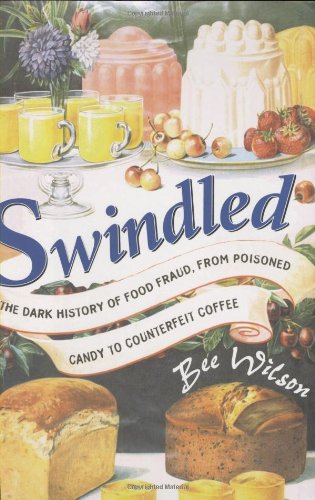
Swindled: The Dark History of Food Fraud, from Poisoned Candy to Counterfeit Coffee by Bee Wilson
Notes about this book
You must Create an Account or Sign In to add a note to this book.Reviews about this book
- ISBN 10 0691138206
- ISBN 13 9780691138206
- Published Sep 08 2008
- Format Hardcover
- Page Count 400
- Language English
- Edition 1st
- Publisher Princeton University Press
Publishers Text
Bad food has a history. Swindled tells it. Through a fascinating mixture of cultural and scientific history, food politics, and culinary detective work, Bee Wilson uncovers the many ways swindlers have cheapened, falsified, and even poisoned our food throughout history. In the hands of people and corporations who have prized profits above the health of consumers, food and drink have been tampered with in often horrifying ways--padded, diluted, contaminated, substituted, mislabeled, misnamed, or otherwise faked. Swindled gives a panoramic view of this history, from the leaded wine of the ancient Romans to today's food frauds--such as fake organics and the scandal of Chinese babies being fed bogus milk powder.
Wilson pays special attention to nineteenth- and twentieth-century America and England and their roles in developing both industrial-scale food adulteration and the scientific ability to combat it. As Swindled reveals, modern science has both helped and hindered food fraudsters--increasing the sophistication of scams but also the means to detect them. The big breakthrough came in Victorian England when a scientist first put food under the microscope and found that much of what was sold as "genuine coffee" was anything but--and that you couldn't buy pure mustard in all of London.
Arguing that industrialization, laissez-faire politics, and globalization have all hurt the quality of food, but also that food swindlers have always been helped by consumer ignorance, Swindled ultimately calls for both governments and individuals to be more vigilant. In fact, Wilson suggests, one of our best protections is simply to reeducate ourselves about the joys of food and cooking.
Other cookbooks by this author
- Consider the Fork: A History of How We Cook and Eat
- Consider the Fork: A History of How We Cook and Eat
- Consider the Fork: A History of How We Cook and Eat
- Consider the Fork: A History of Invention in the Kitchen
- Consider the Fork: A History of How We Cook and Eat
- Consider the Fork: A History of How We Cook and Eat
- Consider the Fork: A History of How We Cook and Eat
- First Bite
- First Bite
- First Bite: How We Learn to Eat
- First Bite: How We Learn to Eat
- First Bite: How We Learn to Eat
- The Heart-Shaped Tin: Love, Loss, and Kitchen Objects
- The Heart-Shaped Tin: Love, Loss, and Kitchen Objects
- The Hive: The Story of the Honeybee and Us
- Sandwich: A Global History
- Sandwich: A Global History
- Sandwich
- The Secret of Cooking: Recipes for an Easier Life in the Kitchen
- The Secret of Cooking: Recipes for an Easier Life in the Kitchen
- The Secret of Cooking: Recipes for an Easier Life in the Kitchen
- Swindled: From Poison Sweets to Counterfeit Coffee - The Dark History of the Food Cheats
- The secret of cooking: Recipes for an Easier Life in the Kitchen
- The secret of cooking
- This Is Not a Diet Book: A User’s Guide to Eating Well
- The Way We Eat Now
- The Way We Eat Now: How the Food Revolution Has Transformed Our Lives, Our Bodies, and Our World
- The Way We Eat Now: How the Food Revolution Has Transformed Our Lives, Our Bodies, and Our World