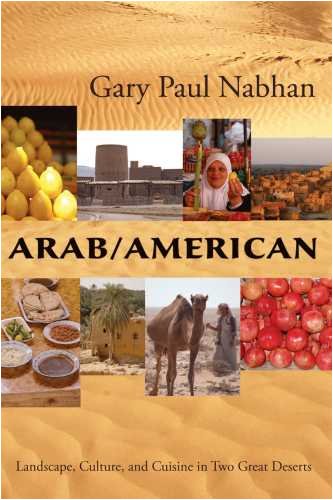
Arab/American: Landscape, Culture, and Cuisine in Two Great Deserts by Gary Paul Nabhan
This book has not been indexed yet...
Notes about this book
You must Create an Account or Sign In to add a note to this book.Reviews about this book
- ISBN 10 0816526591
- ISBN 13 9780816526598
- Published Mar 01 2008
- Format Paperback
- Page Count 160
- Language English
- Edition First Edition
- Countries United States
- Publisher University of Arizona Press
Publishers Text
The landscapes, cultures, and cuisines of deserts in the Middle East and North America have commonalities that have seldom been explored by scientists—and have hardly been celebrated by society at large. Sonoran Desert ecologist Gary Nabhan grew up around Arab grandparents, aunts, uncles, and cousins in a family that has been emigrating to the United States and Mexico from Lebanon for more than a century, and he himself frequently travels to the deserts of the Middle East. In an era when some Arabs and Americans have markedly distanced themselves from one another, Nabhan has been prompted to explore their common ground, historically, ecologically, linguistically, and gastronomically. Arab/American is not merely an exploration of his own multicultural roots but also a revelation of the deep cultural linkages between the inhabitants of two of the world’s great desert regions. Here, in beautifully crafted essays, Nabhan explores how these seemingly disparate cultures are bound to each other in ways we would never imagine. With an extraordinary ear for language and a truly adventurous palate, Nabhan uncovers surprising convergences between the landscape ecology, ethnogeography, agriculture, and cuisines of the Middle East and the binational Desert Southwest. There are the words and expressions that have moved slowly westward from Syria to Spain and to the New World to become incorporated—faintly but recognizably—into the language of the people of the U.S.–Mexico borderlands. And there are the flavors—piquant mixtures of herbs and spices—that have crept silently across the globe and into our kitchens without our knowing where they came from or how they got here. And there is much, much more. We also learn of others whose work historically spanned these deserts, from Hadji Ali (“Hi Jolly”), the first Moslem Arab to bring camels to America, to Robert Forbes, an Arizonan who explored the desert oases of the Sahara. These men crossed not only oceans but political and cultural barriers as well. We are, we recognize, builders of walls and borders, but with all the talk of “homeland” today, Nabhan reminds us that, quite often, borders are simply lines drawn in the sand.Other cookbooks by this author
- Chasing Chiles: Hot Spots Along the Pepper Trail
- Chasing Chiles: Hot Spots Along the Pepper Trail
- Chile, Clove, and Cardamom: A Gastronomic Journey Into the Fragrances and Flavors of Desert Cuisines
- Coming Home to Eat: The Pleasures and Politics of Local Foods
- Coming Home To Eat: The Pleasures And Politics Of Local Foods
- Coming Home To Eat: The Pleasures And Politics of Local Foods
- Cumin, Camels, and Caravans: A Spice Odyssey
- Cumin, Camels, and Caravans: A Spice Odyssey
- Cumin, Camels, and Caravans: A Spice Odyssey
- Desert Terroir: Exploring the Unique Flavors and Sundry Places of the Borderlands
- Desert Terroir: Exploring the Unique Flavors and Sundry Places of the Borderlands
- Enduring Seeds: Native American Agriculture and Wild Plant Conservation
- Jesus for Farmers and Fishers: Justice for All Those Marginalized by Our Food System
- Renewing America's Food Traditions: Saving and Savoring the Continent's 100 Most Endangered Foods
- Renewing America's Food Traditions: Bringing Cultural and Culinary Mainstays of the Past Into the New Millennium
- To Eat with Grace: A selection of writing about food from Orion magazine
- Why Some Like It Hot: Food, Genes, and Cultural Diversity