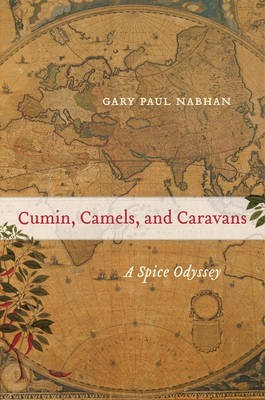
Cumin, Camels, and Caravans: A Spice Odyssey by Gary Paul Nabhan
This book has not been indexed yet...
Notes about this book
You must Create an Account or Sign In to add a note to this book.Reviews about this book
- ISBN 10 0520956958
- ISBN 13 9780520956957
- Published Mar 01 2014
- Format eBook
- Page Count 292
- Language English
- Countries United States
- Publisher University of California Press
- Imprint University of California Press
Publishers Text
Gary Paul Nabhan takes the reader on a vivid and far-ranging journey across time and space in this fascinating look at the relationship between the spice trade and culinary imperialism. Drawing on his own family's history as spice traders, as well as travel narratives, historical accounts, and an ethnobotanical exploration of spices and their uses, Nabhan describes the critically important roles that Semitic peoples and desert floras had in setting the stages for globalized spice trade. Traveling along four prominent trade routes - the Silk Road, the Frankincense Trail, the Spice Route, and the Camino Real for chiles and chocolate - Nabhan follows the caravans of itinerant spice merchants from the frankincense - gathering grounds and ancient harbors of the Arabian Peninsula, to the port of Zayton on the China Sea, to Santa Fe in the desert Southwest. His stories, recipes, and linguistic analyses of cultural diffusion routes reveal the extent to which aromatics like cumin, cinnamon, saffron, and peppers became adopted worldwide as signature ingredients of diverse cuisines. Cumin, Camels, and Caravans demonstrates that two particular desert cultures often depicted in constant conflict - Arabs and Jews - have spent more of their history collaborating in the spice trade and suggests how a more virtuous multicultural but globalized society may be achieved in the future.Other cookbooks by this author
- Arab/American: Landscape, Culture, and Cuisine in Two Great Deserts
- Chasing Chiles: Hot Spots Along the Pepper Trail
- Chasing Chiles: Hot Spots Along the Pepper Trail
- Chile, Clove, and Cardamom: A Gastronomic Journey Into the Fragrances and Flavors of Desert Cuisines
- Coming Home to Eat: The Pleasures and Politics of Local Foods
- Coming Home To Eat: The Pleasures And Politics Of Local Foods
- Coming Home To Eat: The Pleasures And Politics of Local Foods
- Cumin, Camels, and Caravans: A Spice Odyssey
- Cumin, Camels, and Caravans: A Spice Odyssey
- Desert Terroir: Exploring the Unique Flavors and Sundry Places of the Borderlands
- Desert Terroir: Exploring the Unique Flavors and Sundry Places of the Borderlands
- Enduring Seeds: Native American Agriculture and Wild Plant Conservation
- Jesus for Farmers and Fishers: Justice for All Those Marginalized by Our Food System
- Renewing America's Food Traditions: Saving and Savoring the Continent's 100 Most Endangered Foods
- Renewing America's Food Traditions: Bringing Cultural and Culinary Mainstays of the Past Into the New Millennium
- To Eat with Grace: A selection of writing about food from Orion magazine
- Why Some Like It Hot: Food, Genes, and Cultural Diversity