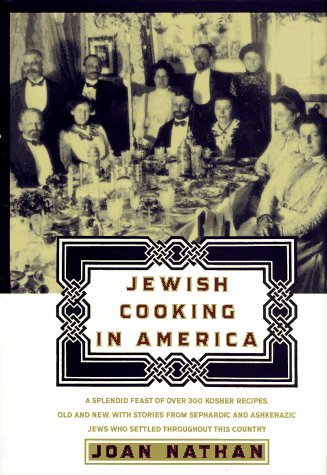
Jewish Cooking in America (Knopf Cooks American Series) by Joan Nathan
Notes about this book
You must Create an Account or Sign In to add a note to this book.Reviews about this book
- ISBN 10 0394584058
- ISBN 13 9780394584058
- Published May 01 1994
- Format Hardcover
- Page Count 463
- Language English
- Countries United States
- Publisher Knopf
- Imprint Alfred A. Knopf
Publishers Text
Here is a rich tapestry of more than three centuries of Jewish cooking in America. In this book Joan Nathan gathers together more than 300 kosher recipes, old and new. They come from both Sephardic and Ashkenazic Jews who came and settled all over America, bringing with them a wide variety of regional flavors, changing and adapting their traditional dishes according to what was available in the new country.What makes Jewish cooking unique is the ancient dietary laws that govern the selection, preparation, and consumption of food by observant Jews. Food plays a major part in rituals, past and present, binding family and community. It is this theme that informs every page of Joan Nathan's warm and lively text.
Every dish has a story--from the cholents (the long-cooked rich meat stews) and kugels (vegetable and noodle puddings) prepared in advance for the Sabbath to the potato latkes (served with maple syrup in Vermont and goat cheese in California) and gefilte fish (made with whitefish in the Midwest, salmon in the Northwest, haddock in New England, and shad in Maryland). Joan Nathan tells us how lox and bagels and Lindy's cheesecake became household words and how American products like Crisco, cream cheese, junket, and Jell-O changed forever the way Jewish women cook.
The recipes and stories come from every part of the U.S.A. They are seasoned with Syrian, Moroccan, Greek, German, Polish, Georgian, and Alsatian flavors, and they represent traditional foods tailored for today's tastes as well as some of the nouvelle creations of Jewish chefs from New York to Tuscany.
Other cookbooks by this author
- An American Folklife Cookbook
- The Children's Jewish Holiday Kitchen: 70 Fun Recipes for You and Your Kids
- The Children's Jewish Holiday Kitchen: 70 Fun Recipes for You and Your Kids
- The Children's Jewish Holiday Kitchen
- The Children's Jewish Holiday Kitchen: 70 Ways to Have Fun with Your Kids and Make Your Family's Celebrations Special
- The Children's Jewish Holiday Kitchen: 70 Fun Recipes for You and Your Kids
- The Flavor of Jerusalem
- The Foods of Israel Today: More Than 300 Recipes--and Memories--Reflecting Israel's Past and Present Through Its Many Cuisines
- Jewish Cookery Book: On Principles of Economy
- Jewish Cooking in America
- Jewish Cooking in America
- The Jewish Holiday Baker: Recipes for Breads, Cakes, and Cookies for All the Holidays--and Any Time of the Year
- The Jewish Holiday Baker: Recipes for Breads, Cakes, and Cookies for All the Holidays--and Any Time of the Year
- The Jewish Holiday Baker Postcard
- The Jewish Holiday Kitchen: 250 Recipes from Around the World to Make Your Celebrations Special
- The Jewish Holiday Kitchen: 250 Recipes from Around the World to Make Your Celebrations Special
- The Jewish Holiday Kitchen
- The Jewish Holiday Kitchen
- Joan Nathan's Jewish Holiday Cookbook
- Joan Nathan's Jewish Holiday Cookbook
- Joan Nathan's Jewish Holiday Cookbook
- King Solomon's Table: A Culinary Exploration of Jewish Cooking from Around the World
- King Solomon's Table: A Culinary Exploration of Jewish Cooking from Around the World: A Cookbook
- My Life in Recipes: Food, Family, and Memories
- My Life in Recipes
- My Life in Recipes: Food, Family, and Memories
- The New American Cooking: 280 Recipes Full of Delectable New Flavors From Around The World As Well As Fresh Ways With Old Favorites
- The New American Cooking
- The New American Cooking
- Quiches, Kugels, and Couscous: My Search for Jewish Cooking in France
- Quiches, Kugels, and Couscous: My Search for Jewish Cooking in France
- Quiches, Kugels, and Couscous: My Search for Jewish Cooking in France
- A Sweet Year: Jewish Feasts, Celebrations, and Recipes for Kids and Their Families
- A Sweet Year: Jewish Celebrations and Festive Recipes for Kids and Their Families
 "Pin It")